 |
|
| Author |
 Topic Topic  |
|
|
Momodou
Denmark
11856 Posts |
 Posted - 29 Feb 2008 : 19:48:11 Posted - 29 Feb 2008 : 19:48:11


|
Veteran Music Promoter Calls for Institutionalisation of The Music Industry
Bai Jack, a veteran Gambian music promoter talks to Art and Music Column on a wide range of issues.
Mr. Jack talks about the need to institutionalise Gambian music which he argues can bring enormous revenue to the industry.
By Musa Barrow
Foroyaa: Could you introduce yourself?
Jack: I was born in the Gambia, was brought up and educated in Banjul. I was the social secretary of a youth organisation known as the Camadons Prior to that as a young person I was very much involved in sport. I joined my first football team when I was just twelve years of age. I was a member of the then Sagu Eleven, a very famous and influential football club. As a member of the Camadons youth organisation, we used to organise many activities in Banjul among them were musical shows, procession and cultural activities all aimed at bringing people together. One of the most significant achievement of the Camadon youth organisation was our annual live musical band shows that we used to have with musical bands such as Gallewar and Ifanbondi.
Foroyaa: What inspired you to venture into the world of music?
Jack: Basically, it was my engagement with those musical bands that I earlier mentioned that truly inspired me to become what I am today. It started since 19977 and I begun actively with a band in 1980.
Foroyaa: How did you start working with a musical band?
Jack: Amazingly I was supposed to become an electrical draft man I had already started training at the Building Control Office to become an architect. After I completed high school my intention was to get a scholarship with a view to pursue higher education. As a trainee at the Building Control Office I was attached to Jeng Electrical Company which then had many contracts all over the country among them was the electrification of the Central Bank which I personally drafted. As a young person, my father had always believed that I would be an artist. In 1971 I was the first Gambian to win the Shankars’ International Children Art Competition Volume Twenty-three and the organisers of competition were based in Bombay, India. About one hundred thousand people took part in the competition.
Foroyaa: What was the Shankars’ International Children Art Competition about?
Jack: This competition was about art, essay, composition and letter writing. Participants were required to design something and explain it. Entry to the competition was open to participants all over the world. I can vividly remember receiving my trophy at the then Ministry of Education, but unfortunately I am yet to receive my certificate which I was told would be sent to me. This trophy was presented to me by the then education minister Kalilu Sighateh. I must say that my trophy got lost in mysterious circumstance and until now I have no idea where it is. In 1976 our youth organisation Camadons quelled a conflict between the fans of two musical bands namely Ifanbondi and Gellewarr by organising a football match between the two set of fans. As youths we felt it was our responsibility to promote unity and understanding amongst people. In 1979 our organisation was the first youth association to take a Gambian musical band Gellewarr outside the country precisely Senegal.In the same year the band recorded on the television in Senegal. In 1980 I started to work with Gellewarr as the manager.
Foroyaa: During your reign as the manager of Gellewarr, what was its major achievement?
Jack: The major achievement was that in 1981 the band released two volumes. This achievement was unprecedented because it was the first of its kind to have happened in this country. As a result of the emergency law which was as a result of the 1981 aborted coup the band had to travel to Senegal where they recorded and proceeded on a tour which lasted for two years. In this tour we visited and performed in many places in Senegal. And during this period, we also signed contracts with many companies. In 1982 the band was taken to court in Senegal resulting in the seizure of our instruments. However, the band stood firm.
Foroyaa: During your tour of Senegal and Mauritania, how were you received?
Jack: The band was warmly received in both Senegal and Mauritania because the name Gellewarr then was a trade mark. The popularity of the band was orchestrated by Lie Ngum who is such an intelligent person. Lie and Musa Ngum used to cause traffic jams in Senegal. I do tell young artists that Gambian music used to be very popular in Senegal; those were the days of Ifanbondi, Gellewarr and Magadan. Those bands earned the country glory, fame and income. Given the fact that most of the people behind our music during those days are still alive, if we institutionalise the music industry we can still move where we want to. Another thing is there is a taste and style of music called the Marinba that is being played in Senegal, the master of that style started his career under my own supervision and he is Mustapha Faye, the keyboard player of Yousou Ndure.
Foroyaa: As a veteran music promoter what is your view of the state of music in the country?
Jack: I think we need to institutionalise music as well as “Gambianise” it. By the latter I mean Gambian music should be given more air time on both radios and television. There should also be a music school where music can be learnt in its truest form. Gambian musicians lack basic facilities which are completely essential to their work. There is no doubt in my mind that there are well qualified people in this country who can share their expertise with youngsters if a music school is established.
Foroyaa: Do you think a music school is the solution to “Gambianise” Gambian music given the fact that some young artists are already influenced by foreign music?
Jack: In the absence of the necessary structures in place, anyone can think that he/she can come and do anything: in such a situation, people take everything without proper scrutiny. In the quest to “Gambianise” our music, people with the know how will be in place to correct things. Another important thing is that a music school goes with a recording facility and a press facility.
Foroyaa: Do you share the view that bringing high profile artists in the country does sideline young Gambian artists?
Jack: I do not think so bringing high profile artists like Morgan Heritage is always an opportunity.
Foroyaa: How would you describe the role of a promoter in music?
Jack: The role of a promoter basically is to secure the intellectual and economic interest of the artist you are promoting. The promoter serves as a link between the product and the people whom the product is to be delivered to. As a promoter one also reveals something which was previously unknown. In order for one to do all these things mentioned above, he/she has to know how to do it and it requires a great deal of hard work and sacrifice. Promoting in Africa is such a daunting job. However, the advent of internet has now made it a bit easier.
Foroyaa: Are Gambian musicians making the best use out of the internet given the enormous opportunities it offers?
Jack: I know of one site called gambiantalent.com that is really selling Gambian music to the outside world. Such sites can take our music forward. Arts can bring a lot to a country, example Jamaica is known all over the world for its reggae music and the returns reggae music brings to Jamaica is simply immense and enormous. There are four fundamental pillars in life and these pillars govern life. These fundamental pillars are tradition, religion, aristocracy and the technocracy which include the artists. Any country that fails to respect its artists is doom to fail.
Foroyaa:At one point in time you were in Europe. What were you doing there?
Jack: I had been in Europe for sixteen years and I returned home just a couple of years back. In Sweden I worked with a music bureau which I had registered with. I used to work with children with special needs. I used music to stimulate the interest of kids who lack self confidence. With the various Gambian bands in Sweden such as the “Fam Tam” magic and Voice of Manding we sued to organise musical shows all over Sweden. These shows turned out to be successful. During my stay in Sweden I was also able to help King Rascuras by recording his first CD for him for free of charge.
Foroyaa:Apart from King Rascuras have you worked or supported any other young Gambian musician?
Jack: I managed the Royal Family, most of whom are now in London. I also assisted the Royal Philosopher who is still in the country. Recently together with my friends Moses Nden and Mr. Saho we have formed a freelance music organisation aimed at helping musicians of this country. This organisation raises awareness and makes Gambians to be aware of what the country can gain through music.
Foroyaa:Over the years many musical bands have emerged only for them to disappear. What would you attribute such development to?
Jack: I would advise any band to think of collective success rather than individual success. Our musicians tend to be driven by the desire to go to Europe and there is an avalanche of musicians in Europe. The only way Gambian musicians can thrive in Europe is for them to play Gambian cultural music which would be unique there.
No matter how good one is, he can never be good as those he imitates.
Foroyaa:What would you say to the saying that music has no boundary?
Jack: Although there is an element of truth in that statement. However, different people have their different style of music.
Foroyaa:What would be your comparison of Gambian music in the 1970s and presently?
Jack: In the 1970s there was a great deal of coordination between artists and people. Secondly performances were also frequent. All these things are not happening these days.
Source: Foroyaa Newspaper Burning Issues
Issue No 24/2008, 27 - 28 February 2008
|
A clear conscience fears no accusation - proverb from Sierra Leone |
|
|
Momodou
Denmark
11856 Posts |
Posted - 29 Feb 2008 : 20:00:24
|
quote:
Jack: .... In 1971 I was the first Gambian to win the Shankars’ International Children Art Competition Volume Twenty-three and the organisers of competition were based in Bombay, India. About one hundred thousand people took part in the competition.
Foroyaa: What was the Shankars’ International Children Art Competition about?
Jack: This competition was about art, essay, composition and letter writing. Participants were required to design something and explain it. Entry to the competition was open to participants all over the world. I can vividly remember receiving my trophy at the then Ministry of Education, but unfortunately I am yet to receive my certificate which I was told would be sent to me. This trophy was presented to me by the then education minister Kalilu Sighateh. I must say that my trophy got lost in mysterious circumstance and until now I have no idea where it is. ......
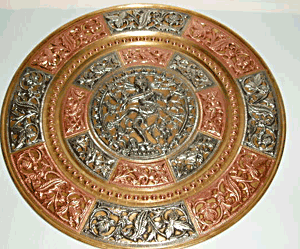
Unlike Mr. Jack I still have my trophy with me which I got from Shankars’ International Children Art Competition in 1974. Mine was presented to me a year later by one Mr. Blain (I think he was the chief education officer at the department of Education). I am also yet to receive any certificate but have a letter from the ministry informing me that I had won the trophy.
 |
A clear conscience fears no accusation - proverb from Sierra Leone |
 |
|
|
Santanfara

3460 Posts |
Posted - 01 Mar 2008 : 11:18:58

|
| congrajulation uncle momodou. i use to be an art lover before. but in my case i never won any prize just an A in secondary fourth. |
Surah- Ar-Rum 30-22
"And among His signs is the creation of heavens and the earth, and the difference of your languages and colours. verily, in that are indeed signs for men of sound knowledge." Qu'ran
www.suntoumana.blogspot.com |
|
|
|
Santanfara
3460 Posts |
Posted - 01 Mar 2008 : 11:20:37
|
| i disagree with mr jack. let him promote his music but why institutionalise it? let him help those interested in his music,if he produce any album ,am sure his fans will buy it. |
Surah- Ar-Rum 30-22
"And among His signs is the creation of heavens and the earth, and the difference of your languages and colours. verily, in that are indeed signs for men of sound knowledge." Qu'ran
www.suntoumana.blogspot.com |
|
|
|
kobo

United Kingdom
7765 Posts |
Posted - 01 Mar 2008 : 19:46:02
|
Wishing Brother Bai every success as they deserve ALL ENCOURAGEMENT & SUPPORT to our talents! He been in this industry since he was a kid. He is also VERY KIND HEARTED PERSON & GOOD PERSONALITY!
From me lots of RESPECT! |
|
|
|
Momodou
Denmark
11856 Posts |
Posted - 06 Mar 2008 : 16:04:06
|
Art & Music
Veteran Music Promoter Calls For Institutionalisation of The Music Industry
Part 2
By Musa Barrow
Foroyaa: How active were Gambian musical bands in the 70s and 80s?
Jack: In those days every sport activity and exhibition organised by schools used to be accompanied by musical displays. Musical bands such as lovers band which gave birth to Magaden Band, Ifanbondi and Gellewarr used to appear in sport activities at the then MacCarthy Square. Furthermore, I would love to put the message across that on a day like Independence Day entertainment should be done by Gambian artists. It is absolutely wrong to invite foreign artists to perform on such an occasion. The collasal sum of money often given to these foreign artists could have been spent prudently.
Foroyaa:Another musical group that you worked with was Libadorr, how did that band start?
Jack: Libadorr band was initiated by Alhagie Mustapha Faye who worked in Saudi Arabia. He truly had a great love and passion for music. During one of his visits to London he bought musical instruments and transported them to Gambia. Initially Ebou Jobarteh managed Libadorr which lasted for a year. There was a musical programme at the customs department in Banjul where Libadorr Ifanbandi and Kulanjang, the band I was managing, performed. As a result of my promotional prowess Kulanjang band was able to steal the show. My band turned out to be the favourite of the crowd. After having released what I was capable of doing, the management of Libadorr band invited me to work with them promising me twenty percent of what the band earned. It was from that moment that I started working with Libadorr. The band lasted for a little over one year as a result of a split. After a while the boys of Libadorr returned to me asking me for the rekindling of the band. I then started work with them again. However. this time we had to rent instruments because we did not have instruments of our own. We used to rent instruments belong to Oko Drammeh. Apparently, the cost involved in renting instruments was very high, leaving members of the band with very little income. While we were undergoing such a difficult time I also bought instruments for the band. The second phase of Libadorr, fully managed, began in 1986.
I’m the first musical manager in this country to have a band, own the instruments, pay electricity as well as food and have equal shares with the musicians from whatever is earned.
Foroyaa:How long did Libadorr last?
Jack: The band lasted for a period of six years, infact it should have lasted more than that.
Foroyaa:In 1992 you were part of a group that organised a carnival on the beach. How was this musical carnival like?
Jack: Myself and my friend Abdoullah Ngum orgnisaed a carnival on the beach aimed at parading all Gambian musicians on a single stage. Although initially we thought of many avenues, we finally concluded to stage it on the beach. This programme started at 11pm and ended at 3am. And it was attended by many well known Gambian artists such as Jaliba Kuyateh and Musa Ngum. This programme which turned out to be a success was organised to show to the then government what the country had in terms of music and musicians.
After this show I had high expectations, the then governments response was disappointed. Nothing came from the government, which compelled me to travel to Europe. However, my decision to travel to Europe was not driven by the quest to look for greener pastures. Instead it was a reaction to the sorry state of music in those days.
Foroyaa:Among all the musical groups that you worked with which one would you describe as the most successful.
Jack: It is rather difficult to give a definite answer. But thee were individual successes within the groups that I had worked with. Almost all the bands that I had worked with have experience on European platform and recordings. Let me cite an example of such individuals success. Michael Gomez who was my keyboard player and background singer at Libadorr is now a full fledge musician based in Germany.
Other examples are Damu Jaw who was my former drummer now based in London and Osuman Njie who is now based in Holland. As a band their achievements were limited, but most of them excel as individuals.
Our recently formed panel called the Way Forward has managed to spot and support Chamelion band who are now playing at the Coconut every Saturday.
In addition the Way Forward is an opened forum and anyone with positive ideas is invited to share it with the panel.
Foroyaa: How was the concept of Way Forward conceived and what are its objectives?
Jack: The Way Forward is a freelance panel and it was initiated by Moses Nden. The Way Forward panel aims to among many things support artists and sensitise people on the significant of art. Furthermore, although art is a coordinal pillar of the Way Forward panel. However, it also talks about social issues affecting the life if the people in this country.
Foroyaa: Apart from radio discussions what has been some of the achievements and engagement of the Way Forward panel?
Jack: The panel has been able to produce Ndey Nyang, widow of late Ousou Lie Njie with Fawegam at the Sunwing Hotel. The panel also on regular basis visit and counsel Gambian artists. The panel with collaboration from various interested partners had also organised a musical show where over thirteen Gambian bands were invited to perform.
Currently, we have got plans to organise such programme in other places. Let me stress that we are embarking on all these activities out of our individuals generosity, as we bear the financial brunt of the activities that we embark on. We are doing all these things because have passion about Gambian music.
Foroyaa: What has been the reaction of Gambians towards you this panel discussions?
Jack: Apparently Gambians have been very receptive of this open forum. We always stress that we are just there to coordinate things, but it is after all the listeners who are expected to come up with suggestions.
We also try to put across the message that let us all work assiduously inorder to give a brighter future to Gambian music.
Foroyaa: How would you spell out the role of a manager to a musician?
Jack: The role of a manager in music cannot be over emphasised. All musicians need a manager. The fact of the matter is one cannot be an artist at the same time protecting his/her economic interest as well as run an administration. Such role are handled by a manager. Nevertheless, for one to be a manager he/she must know how to go about things in the world of music.
Foroyaa: Is the copyright law in Gambia really implemented to the fullest?
Jack: The copyright law is not active in this country. This is understandable because it really takes time to put everything together. Moreover every royalty board is bang formed as a society by artists. The artists must come together to secure their interests, works, intellectual property and performing rights. Establishment of a copyright bureau is also essential as it can be a source of employment for the unemployed youths who can be turned to copyright police.
Foroyaa: How big a threat is piracy to Gambian music?
Jack: Regardless of its magnitude piracy is illegal and all measures should be taken to put an end to the practice.
Foroyaa: Is The National Council for Art and Culture doing what is expected of them?
Jack: The National Council for Art and Culture needs a musical department and some one who knows the constraints of Gambian musicians. Having said that, musicians of his country should first of all organise themselves into a sort of an association. As an association they can out forward proposals and demands on the council. Until this is done the council cannot fully support artists.
Foroyaa: Despite Gambia having some of the best instrumentalists, why is it that Gambian music is only secondary to music of other countries in the sub region?
Jack: This is due to the fact that Gambian music is not being given the respect it deserves. Recently we had to raise concern that a Gambian company brought Fatou Gewel from Senegal and paid her one hundred and eight thousand dalasi, surprisingly the same company paid Sambou Susso who also performed on the night fifteen thousand dalasi. Such things are ludicrous and unacceptable.
Source:Foroyaa Newspaper Burning Issues
Issue No. 27/2008, 5 – 6 March 2008 |
A clear conscience fears no accusation - proverb from Sierra Leone |
|
|
| |
Topic |
|
|
|
| Bantaba in Cyberspace |
© 2005-2024 Nijii |
|
|
|



 Topic Locked

